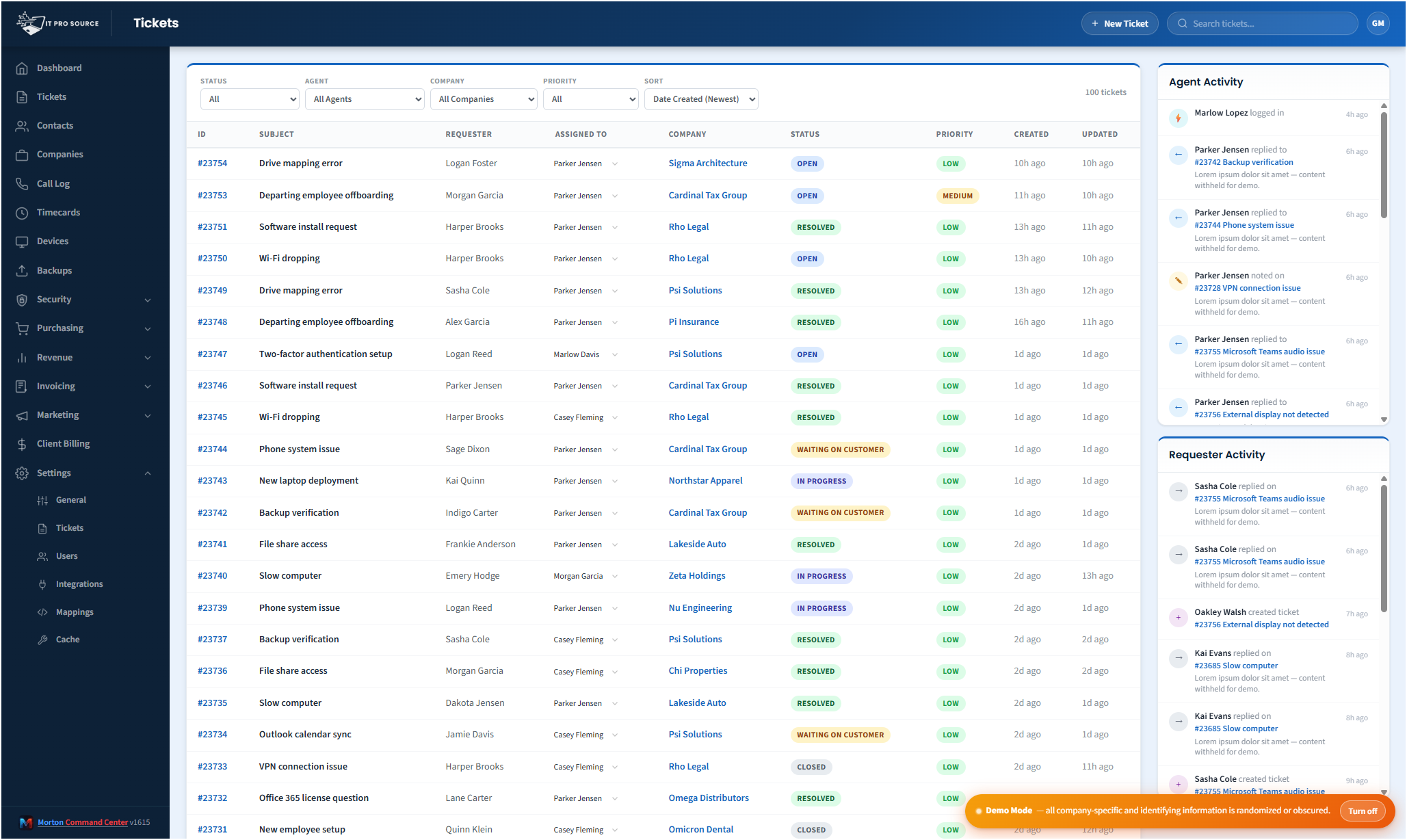
HaloPSA is one of the more capable PSAs on the market, especially for MSPs that have outgrown Syncro or Atera. The configuration depth is genuine. So is the configuration burden — many Halo deployments take three to six months to feel "right," and the platform's strength becomes a liability when your workflow doesn't quite map onto its assumed structure.
What MSPs run into with Halo
- Configuration sprawl. Hundreds of settings, custom fields, automations. Power users love it; teams new to Halo can spend months tuning before it feels operational.
- Per-seat pricing. Per-agent monthly fee. Scales with team size.
- Integration breadth vs depth. Halo integrates with many things, but the depth of each integration varies — and customizing the integration logic isn't always easy.
- Reporting limitations. Strong out of the box for standard MSP reporting; cumbersome for anything that doesn't match the built-in shapes.
How Command Center compares
Morton Command Center isn't trying to be a configurable platform. It's trying to be your MSP's exact platform. Instead of giving you 800 settings to tune, we observe your team's workflow once during discovery, then build a system that does exactly that. There is nothing to "configure" because the configuration is the build.
You also keep using a real ticket system underneath — Freshdesk, ConnectWise, Halo itself, or whatever fits — and Command Center handles the unified operations layer on top. The result is a platform that's operational on day one and tuned to your actual workflow, not a vendor's default workflow.
Concrete differences
- Time to operational. Halo: weeks to months of configuration. Command Center: 2-4 weeks total, including the build itself.
- Pricing model. Halo: per-agent. Command Center: $1,600/month flat, unlimited users.
- Customization model. Halo: configuration screens. Command Center: code that does what you actually need.
- Stack flexibility. Halo wants to be the system of record. Command Center is the orchestration layer — your existing tools stay.
When Halo still wins
Honest answer: Halo is the right call when you genuinely want a single PSA-of-record handling tickets, billing, projects, contracts, and CRM in one product, and you have the team capacity to invest months in configuring it. If you've already built a deep Halo deployment and it's working, there's no reason to walk away.
Command Center wins when you'd rather keep best-of-breed tools (Freshdesk for tickets, QuickBooks for billing, NinjaOne for endpoints) and need a unified operations dashboard on top — without paying per-seat for the privilege.
Pricing
Morton Command Center uses transparent flat pricing. There is one build fee, one monthly hosting fee, and one monthly reserved-hours block — no per-seat surprises and no annual escalators tied to your team size.
- $5,500 one-time build. Your custom platform — discovery, integrations, branding, deployment.
- $350 / month flat hosting. Edge infrastructure, security patches, vendor API key management, uptime monitoring.
- $1,250 / month reserved hours. Ten reserved engineering hours every month for tweaks, new integrations, or feature requests. Unused hours roll over.
Founding Five pricing. The first five MSPs to sign on lock in this rate for the lifetime of their account. Standard pricing — for everyone after — is expected to be roughly 50% higher. Founding Five rates never change, even as the platform grows.
Related solutions
Morton Command Center is built around your specific stack. If this page resonates, these adjacent angles probably will too:
- ConnectWise Alternative — The bigger PSA escape route.
- Syncro Alternative — Halo is often the upgrade path from Syncro — here’s another option.
- Custom MSP Platform — How a one-of-one build fits your workflow.
- No Per-Seat Pricing — Flat-fee math vs per-agent.
Ready to talk?
The first call is a 30-minute discovery — we map your existing tools and workflows together, scope what a custom Command Center build would look like for your MSP, and decide whether the fit is right. No commitment, no sales pressure.
Questions first? Email [email protected] or read the FAQ.