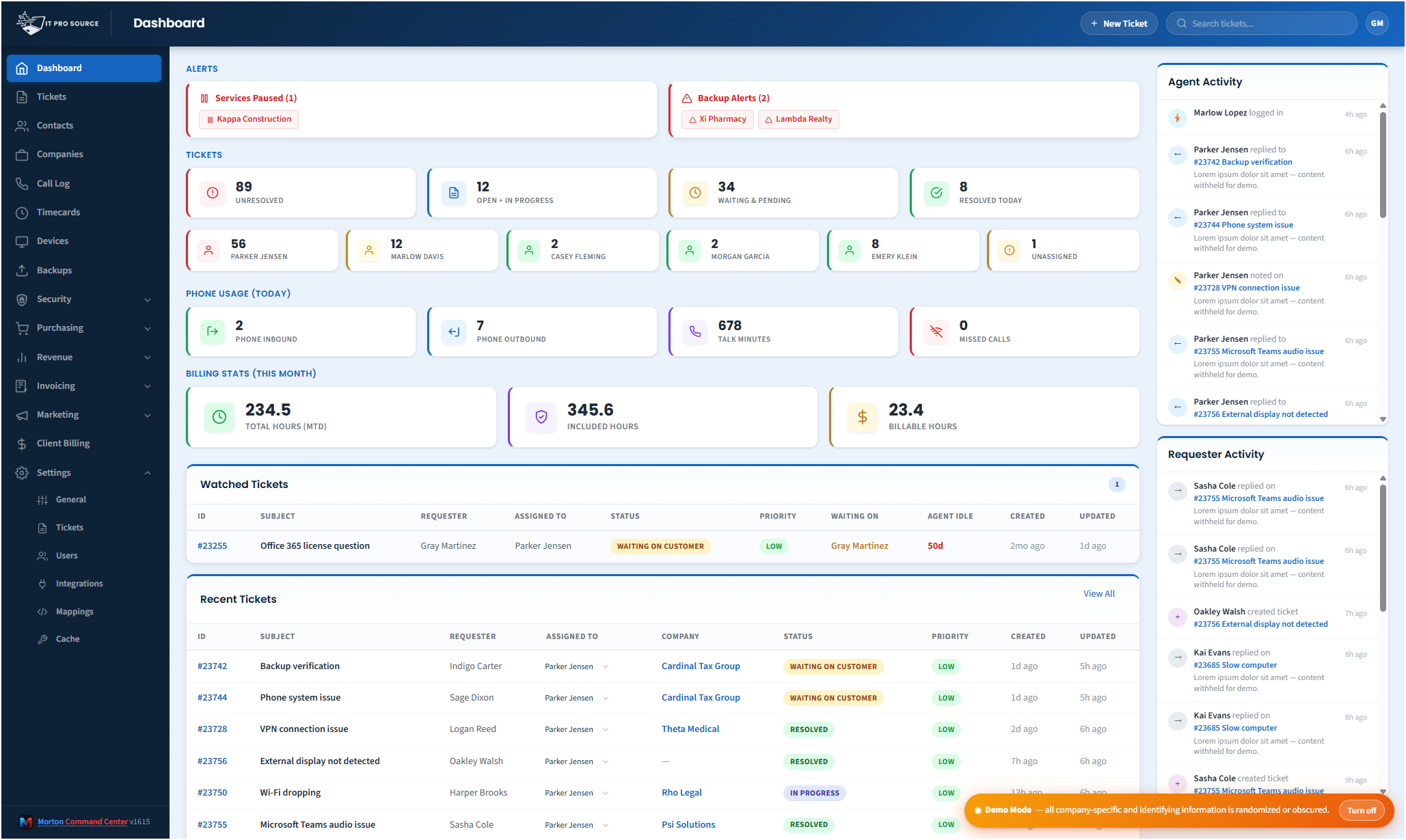
Every MSP eventually faces the same question: keep paying for an off-the-shelf platform that doesn't quite fit, or invest in something custom that does. There are three real options. Each is right for a specific kind of MSP. Here's an honest framework for picking yours.
Option 1: Off-the-shelf SaaS
Examples: ConnectWise Manage, Autotask PSA, HaloPSA, Syncro, Atera, Kaseya BMS.
Best for: MSPs that fit cleanly inside a vendor's assumed workflow. If you're a generalist SMB MSP doing standard ticket-and-billing work, with no unusual industry requirements (healthcare, defense, etc.), and you're under twelve technicians, off-the-shelf will probably serve you fine. Sign up, configure for two months, and you're operational.
Tradeoffs: Per-seat pricing scales with headcount. The roadmap is whatever the vendor decides. Integrations are limited to what they've built. The moment your workflow needs something the platform doesn't support, you fall back on spreadsheets and tabs. Lock-in is real — your data lives in their database, and migrating off is a multi-month project.
Option 2: Hire an in-house developer
Best for: Very large MSPs (50+ techs) with the budget and management bandwidth to run a permanent software team. If you're in this bucket you probably already are.
Tradeoffs: A senior full-stack developer in the US costs $150-200K all-in per year. To do this well you actually need two — one is a single point of failure. Then you need infrastructure, on-call, security review. A real in-house team is $400K+ per year before they ship anything. The result is the most customized possible platform, but the floor is too high for any MSP under about $20M revenue.
Option 3: One-of-one custom build (Morton Command Center)
Best for: MSPs in the messy middle — too custom for off-the-shelf to fit cleanly, too small for a real in-house dev team. Typically 5-30 technicians, multiple integrations, opinionated workflows that have been refined over years.
How it works: We build a custom platform around your specific stack and workflows in two to four weeks. The platform sits on top of a battle-tested edge-native foundation (Cloudflare Workers, AWS SES, Clerk auth) so we're not reinventing the engine. You pay $5,500 once for the build, $350/month for hosting, and $1,250/month for ten reserved engineering hours that handle ongoing tweaks and new integrations.
Tradeoffs: Two-to-four-week wait to be operational. Smaller-vendor risk profile vs ConnectWise (mitigated by your data staying in your existing tools — there's nothing to migrate off if you ever leave). You're trusting a small team rather than a thousand-person company.
The honest decision tree
- Fewer than 5 technicians, standard workflow: Buy off-the-shelf. Your time is better spent on customer work than custom platforms.
- 5-30 technicians, accumulated workflow opinions, integration sprawl: Custom build wins. The flat-fee math beats per-seat by year two, and the workflow fit pays for itself immediately.
- 30+ technicians, deep operational complexity, regulated industry: Custom build still wins, but you may also want in-house dev capacity for ongoing changes.
- 50+ technicians, capacity for permanent dev team: Hire in-house and use Morton Command Center as your reference architecture.
What about hybrid?
The most common pattern: keep your favorite off-the-shelf tools (Freshdesk, NinjaOne, QuickBooks) and use Morton Command Center as the unified layer on top. You get the proven foundations of mature SaaS for ticketing/RMM/accounting, plus a custom orchestration platform that fits your team. This is what we recommend for most MSPs in the 5-30 range.
Pricing
Morton Command Center uses transparent flat pricing. There is one build fee, one monthly hosting fee, and one monthly reserved-hours block — no per-seat surprises and no annual escalators tied to your team size.
- $5,500 one-time build. Your custom platform — discovery, integrations, branding, deployment.
- $350 / month flat hosting. Edge infrastructure, security patches, vendor API key management, uptime monitoring.
- $1,250 / month reserved hours. Ten reserved engineering hours every month for tweaks, new integrations, or feature requests. Unused hours roll over.
Founding Five pricing. The first five MSPs to sign on lock in this rate for the lifetime of their account. Standard pricing — for everyone after — is expected to be roughly 50% higher. Founding Five rates never change, even as the platform grows.
Related solutions
Morton Command Center is built around your specific stack. If this page resonates, these adjacent angles probably will too:
- Custom MSP Platform — What the custom build actually includes.
- No Per-Seat Pricing — The cost math vs off-the-shelf SaaS.
- Consolidate Your MSP Stack — The hybrid pattern explained.
- ConnectWise Alternative — A specific build-vs-buy comparison.
Ready to talk?
The first call is a 30-minute discovery — we map your existing tools and workflows together, scope what a custom Command Center build would look like for your MSP, and decide whether the fit is right. No commitment, no sales pressure.
Questions first? Email [email protected] or read the FAQ.