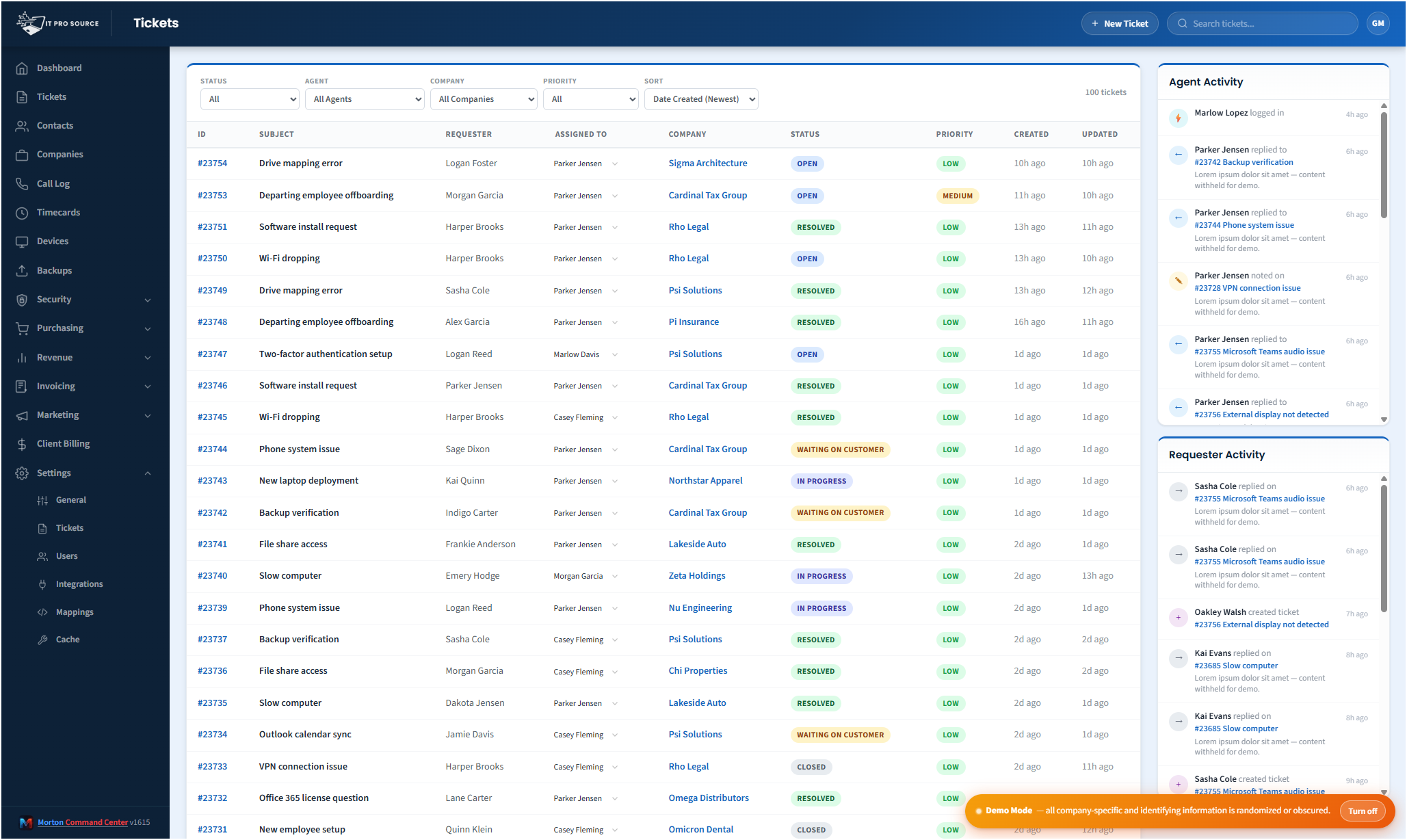
Freshdesk and NinjaOne are an excellent best-of-breed stack: Freshdesk gives you a fast, flexible ticket system; NinjaOne gives you affordable, capable RMM. The downside is they don't talk to each other natively — your techs swap tabs all day, your billing closeouts cross-reference both systems by hand, and your reporting lives in two places.
Morton Command Center is the operations layer that makes Freshdesk and NinjaOne behave like one product, custom-built around your MSP's specific workflow.
What gets unified
- Tickets show device context inline. Open a Freshdesk ticket and the related device's NinjaOne health, patch status, last reboot, and other open tickets surface automatically.
- Devices show ticket history. Open a NinjaOne device and every ticket that's ever touched it appears, with one-click navigation back to Freshdesk.
- Customer view is one screen. Per-company dashboards merge Freshdesk tickets, NinjaOne devices, billing rules, recent backups, and security findings in one tabbed view.
- Billing pulls from both. NinjaOne device counts auto-populate the per-device line items in invoices. No manual reconciliation.
- Reporting crosses systems. Tickets per device, devices per ticket-volume bucket, mean-time-to-resolve by device class — none of these exist natively in either tool.
How the integration actually works
Both Freshdesk and NinjaOne expose mature REST APIs. Command Center polls each on a schedule (typically every 1-5 minutes for tickets, 15-30 minutes for device inventory) and caches the merged view in Cloudflare KV. The result: sub-second page loads, no live API hops on every click, and zero configuration needed inside Freshdesk or NinjaOne — everything is read-only on their side.
The cache invalidates when either system reports updates via webhooks (where supported) or on the next poll cycle. For action-taking — replying to a ticket, rebooting a device — Command Center calls the source API directly, so there's no risk of acting on stale state.
What stays in Freshdesk and NinjaOne
Everything. Your tickets are still in Freshdesk. Your device records are still in NinjaOne. Your historical data is intact. If you ever wanted to walk away from Command Center, you'd open Freshdesk and NinjaOne and find them exactly as you left them — no migration, no data hostage situation.
Beyond the unified view
Once Freshdesk and NinjaOne are unified, Command Center becomes the natural place to add the MSP operations Freshdesk and NinjaOne don't cover: customer portal (branded, with ticket and device visibility), billing automation (pulling from NinjaOne device counts and Freshdesk time entries), security operations (rolling up Huntress, Cork, Defender), procurement (Pax8 and Ingram quotes), and operational reporting that crosses every system.
This is the most common Morton CC starting stack
Roughly 60% of Morton Command Center deployments use Freshdesk + NinjaOne as the underlying foundation. It's the combination we've integrated most deeply, and the one with the most production hours behind it. If this is your stack, you're in the easy path.
Pricing
Morton Command Center uses transparent flat pricing. There is one build fee, one monthly hosting fee, and one monthly reserved-hours block — no per-seat surprises and no annual escalators tied to your team size.
- $5,500 one-time build. Your custom platform — discovery, integrations, branding, deployment.
- $350 / month flat hosting. Edge infrastructure, security patches, vendor API key management, uptime monitoring.
- $1,250 / month reserved hours. Ten reserved engineering hours every month for tweaks, new integrations, or feature requests. Unused hours roll over.
Founding Five pricing. The first five MSPs to sign on lock in this rate for the lifetime of their account. Standard pricing — for everyone after — is expected to be roughly 50% higher. Founding Five rates never change, even as the platform grows.
Related solutions
Morton Command Center is built around your specific stack. If this page resonates, these adjacent angles probably will too:
- Consolidate Your MSP Stack — The general consolidation pattern.
- Automated MSP Invoicing — Where the device-count automation pays off.
- NinjaOne + Huntress + Cork — Adding security to the same stack.
- MSP Operations Efficiency — The time savings from killing tab swaps.
Ready to talk?
The first call is a 30-minute discovery — we map your existing tools and workflows together, scope what a custom Command Center build would look like for your MSP, and decide whether the fit is right. No commitment, no sales pressure.
Questions first? Email [email protected] or read the FAQ.