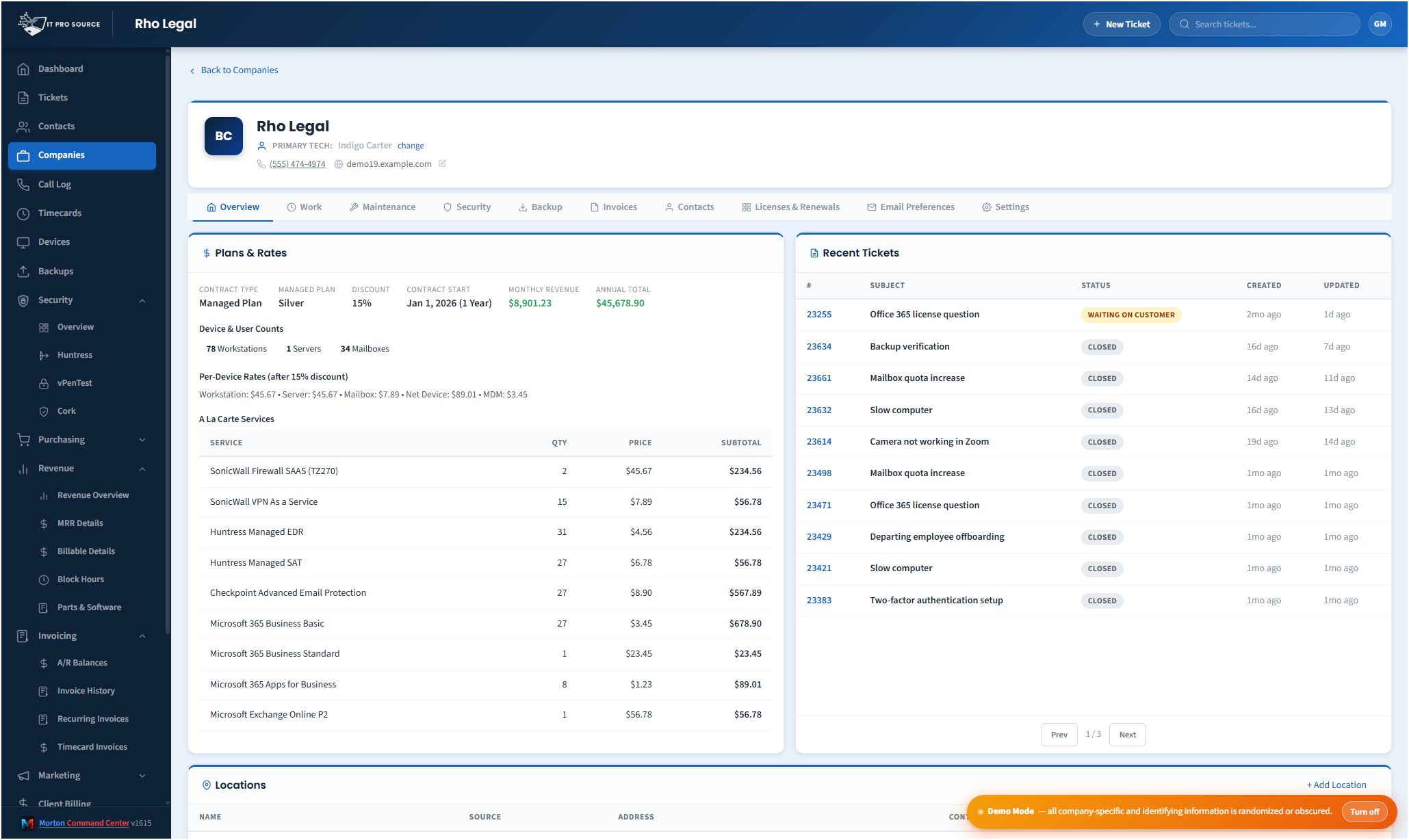
Healthcare clients are different from the rest of an MSP's book. The compliance overhead is heavier (HIPAA, sometimes state-specific requirements), the documentation expectations are stricter, the audit trail matters more, and the consequences of getting security wrong are existential for the practice. Generic MSP platforms don't reflect this; healthcare MSPs end up bolting custom workflows on top. Morton Command Center is a one-of-one build (the compliance workflows, the portal role structure, the integration touch points), all shaped to how your MSP and your healthcare clients actually operate, not configured around a feature set that's identical for every customer.
Morton Command Center is built by MortonApps and runs every day at IT Pro Source, an MSP whose primary clients are Hinds Hospice and Hospice of San Joaquin: healthcare organizations with full HIPAA exposure. The platform's design reflects what those operations need.
What healthcare MSPs need that generic platforms don't deliver
- Nothing new to secure. Morton Command Center reads operational metadata from the tools you already run. It does not store patient records, so adopting it adds no new patient-record system to your environment.
- Audit trail with intent. Security-relevant events (logins, role and scope changes, permission edits) are logged to a built-in audit trail you can review when a security officer or auditor asks who did what, and when.
- Customer portal with role separation. Practice contacts get role-appropriate views: the admin who manages IT sees operational data; staff with limited access see only what they need. Access levels are set by your MSP during the build to match how the practice actually delegates.
- Backup posture as compliance evidence. Backup health rolls up into reports formatted for security officers and HIPAA documentation.
- Patch and vulnerability visibility: patch status surfaced from your RMM and vulnerability findings from your security tools, rolled up so the evidence is easy to pull for a security review.
- EDR / MDR integration: if your healthcare clients standardize on Huntress, SentinelOne, CrowdStrike, or another EDR, that connector is built custom to your stack as part of your engagement. If your tool has an API, we build the integration.
The vertical-specific touches
Hospice in particular has workflow nuances most MSP platforms don't anticipate. Multiple sites with shared and dedicated staff. Your EHR system (Suncoast, Hospicelink, or whatever your clients run) needs integration touch points, and because the platform is API-driven, any EHR with an API connects the same way. After-hours coverage for urgent care needs that map to MSP after-hours response SLAs. We've encoded the patterns we learned at ITPS into the foundation: they translate cleanly to other healthcare MSPs.
For primary care, dental, behavioral health, and specialty practice MSPs, the same compliance backbone applies, with workflow customization during the build to match the specific practice management and EHR systems your clients run. If your clients run any EHR or practice management system that exposes an API, that connector is part of the custom build, not a vendor-roadmap request you wait on.
The HIPAA conversation
Morton Command Center is designed to minimize PHI exposure. The platform itself rarely needs to handle PHI directly: it reads operational metadata (ticket counts, device health, backup status, license usage) from your existing tools, not patient records. Where PHI does cross the platform (typically inside ticket descriptions or attachments), it's encrypted in transit and at rest, and security-relevant access is logged. No business associate agreement is in place for Morton Command Center today, and the AI tools we use to support the platform run without one (see our Privacy Policy). Our Terms of Service do not allow PHI in the platform unless we have signed a business associate agreement with you, so talk to us before your clients' PHI flows through it.
Your underlying tools (PSA, RMM, EHR) stay exactly where they are and keep their own agreements. Morton Command Center reads from them and stores only what it needs, such as records you create in it. There is no data migration and no cutover window: it just makes operating across those tools easier without weakening the audit trail. If your tool has an API, we support it.
What ITPS taught us
About six months of running healthcare MSP operations through Morton Command Center inside ITPS has produced a clear pattern: the consolidation gain is even larger in healthcare than in generic MSP work, because the documentation overhead is so much higher. Anything that reduces the time spent assembling evidence for QBRs, audits, and security reviews has outsized impact. The MSPs we've spoken to in healthcare consistently report this is the area where Morton Command Center pays for itself fastest. See the full IT Pro Source story →
Pricing
Morton Command Center uses transparent flat-rate pricing. No per-seat, per-endpoint, or per-ticket fees. Onboarding a new hospice site or adding techs during a growth push doesn't change your bill. No per-seat surprises as your healthcare book grows. See current pricing on the homepage →
Launch pricing is active through December 31, 2026: sign up by then and your rate is locked in for life.
Ready to give your healthcare clients an audit-ready answer?
The first call is a 30-minute discovery: we map your HIPAA obligations, your security and backup vendors, and the portal roles each practice needs. No commitment, no sales pressure.
Questions first? Email [email protected] or read the FAQ.
Related solutions
Morton Command Center is built around your specific stack. If this page resonates, these adjacent angles probably will too:
- MSP Security Operations: the security backbone healthcare needs.
- Backup Monitoring: backup as compliance evidence.
- White-Label Client Portal: role-separated portal for healthcare orgs.
- SMB MSP Software: for MSPs whose book is mostly SMB.
- Legal MSP Software: law firms, where confidentiality and scoped access matter just as much.
- Financial Services MSP Software: accounting and financial clients with the same security-and-recoverability bar.